

- 博客访问:9925
- 博文数量: 378
- 用 户 组: 普通用户
- 注册时间:2026-08-26
- 认证徽章:
个人简介
爱情公寓2


推荐博文
料理仙姬
2026-08-26
分类: 诡域新娘
料理仙姬
阿根廷1-1追平英格兰!恩佐世界波挂死角_我的网站

一 |
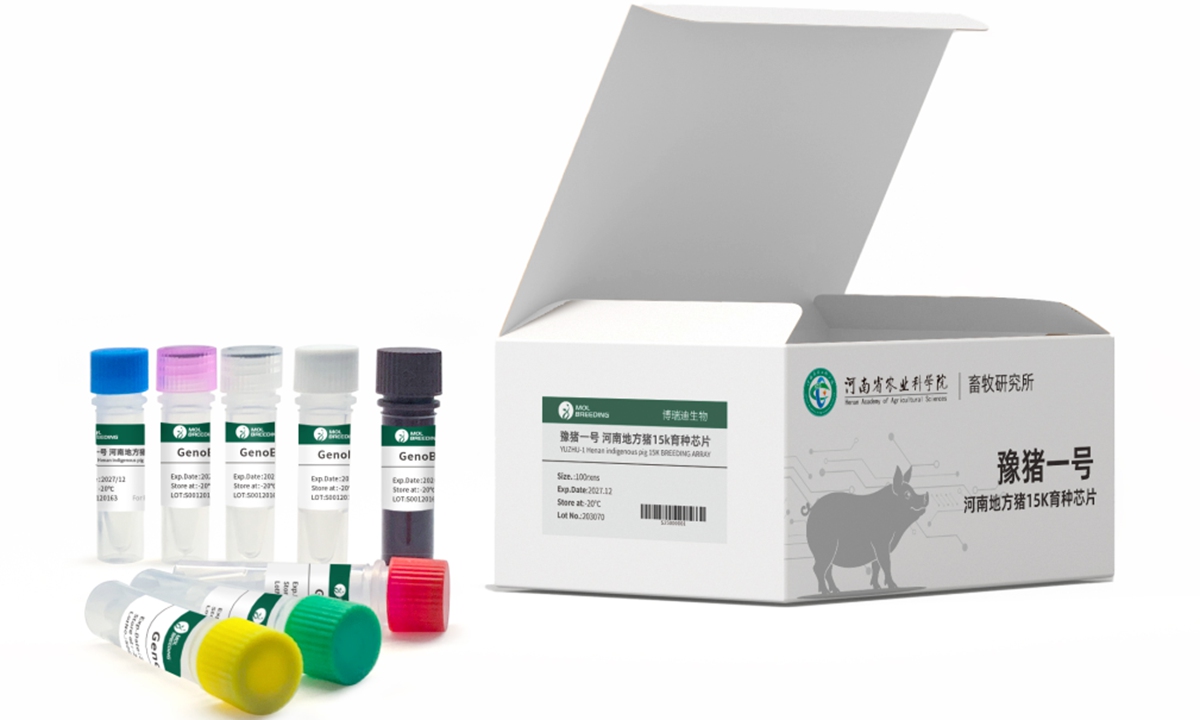
China's largest pork-producing province has introduced a genomic breeding tool designed for indigenous pig breeding, a sign that the province is shifting from expanding volume toward improving hog quality.
The Henan Academy of Agricultural Sciences announced the launch of Yuzhu-1 Henan indigenous pig 15k breeding array - commonly known as a gene chip - developed by the pig breeding team at its Institute of Animal Husbandry and Veterinary Science. It is the first such tool customized for the province's native pig stock, the institute said on Monday.
Henan is home to multiple native pig breeds prized by consumers for their good flavor. However, they carry a commercial burden compared with imported lean-meat breeds, as they grow more slowly, consume more feed per kilogram of weight gain and deliver thinner margins, noted Xing Baosong, head of the pig research office at the institute.
Lifting those hurdles depends on sharper selection, which in local herds has long relied on visual assessment of physical traits, which is slow and imprecise. Genomic tools can speed things up, but mainstream commercial chips were built on imported breeds and lose accuracy on native Chinese stock. Yuzhu No 1 instead draws on whole-genome resequencing data from five of Henan's native pig breeds and two locally bred lines.
"In breeding we rely on estimated breeding values to judge an animal's genetic potential," Wang Ligang, a professor at the Institute of Animal Sciences under the Chinese Academy of Agricultural Sciences, told the Global Times on Monday. "An array matched to the breed makes that estimate more accurate. Previously there was a real chance we were selecting the wrong animals. Now we are far more likely to be selecting the right ones - and to select accurately for the traits a breed is known for, whether that is tender meat or high fertility."
The efficiency gap between native and imported pig breeds remains wide, said Wang, who is also with the Pig Branch of the Chinese Association of Animal Science and Veterinary Medicine. Feed conversion ratios for local Chinese pigs run around 3.0, against below 2.5 for imported breeds, while reaching 100 kilograms takes native pigs 180 to 190 days compared with 130 to 140 days for exotic lines, he said.
Despite this, China's native pig breeds have their advantages.
"Our pigs taste better, partly because they are raised longer," Wang said. "And they are far more robust. Exotic breeds can suffer heat stress and die in summer; when disease hits, they can go down in large numbers. Local pigs rarely do. They tend to recover. Some breeds in Northeast China can even tolerate severe cold."
He added that imported breeds drive efficiency, while native breeds ensure quality and offer a reservoir of genetic diversity for disease and stress resistance - traits that can be bred back into commercial lines.
The province slaughtered 64.74 million pigs in 2025, up 7.4 percent year on year, with pork output at 5.22 million tons, according to the provincial statistics bureau, making it the top pork and pig producer nationwide, according to industry statistics.
In the first half of 2026, pig slaughter in the province rose a further 6.4 percent, accelerating 5.3 percentage points from the first quarter, against national growth of 1.7 percent. Xing said that more high-quality local black pigs will reach the market as Yuzhu No 1 is applied more broadly.
Other major pig production provinces such as Southwest China's Sichuan, Northwest China's Shaanxi and South China's Yunnan have all developed their own arrays.
"Provinces with the most developed pig production are the ones pushing upmarket," Wang said. "Scale is no longer the only measure. If every province reaches this level, a pattern of one dedicated array per province could gradually take shape for China's native breeds."
。

二 |
直播吧07月16日讯 英格兰vs阿根廷第86分钟,恩佐弧顶世界波挂死角!梅西送助攻!阿根廷1-1扳平英格兰!
。
三 |
Current article:http://nwfo5ex.tuncuansazhuandengqiaofen.bond/list_9ewyq3/muwi.html
Published on:03:34:22
相关热门文章
- 财报公布在即 分析师关注英伟达融资、市场份额等
- LUNA SEA真矢さん急死 妻・石黒彩 大きなショックの中で喪主務めた 闘病の夫を最後まで支え
- 【透视社·履新动态】赵建玲任三门峡市委副书记
- 4 dead, 61 injured in prison fire in Iran
- Token不够用了!AI时代最火“新生意”|WAIC观察
- 《传奇之梦》复古合击8月24日删档首测,搜打撤玩法重磅首推!
- 长鑫科技:首次公开发行超额配售选择权全额行使
- 还能改命吗?曼联排第14想进欧冠得靠欧联 去年第8靠足总杯进欧联
- 青山湖科技城配套将更完善 硬科技产业客厅项目明年投用
- घाटा के बाद भी Tata Steel में कर्मचारियों को 16.68 प्रतिशत बोनस, जाने किसे कितना मिलेगा लाभ
- 佳明旗下 Fenix 9/Pro 智能手表曝光:可选半反半透屏太阳能充电版本
- 这次街头暗杀,传递了两个很不祥的信号
- 区人大调研打击治理电诈工作开展情况
- 盘活停车场空间 商场门前建起体育公园
- 视频丨直击撒马尔罕国际机场欢迎现场


